Blog
FOXO4-DRI: The precision architect of cellular renewal

FOXO4-DRI: The Precision Architect of Cellular Renewal
In the rapidly evolving landscape of regenerative science, few compounds have generated as much academic “pulse” as FOXO4-DRI. Often discussed alongside the most significant breakthroughs in biogerontology, this D-Retro-Inverso peptide represents a fundamental shift in how we approach the biology of ageing.
For the modern researcher, FOXO4-DRI is not merely another catalogue entry. Instead, it is a surgical tool designed to solve one of nature’s most stubborn problems: the “Zombie Cell.” At River Peptides, we recognise that breakthroughs require uncompromising quality. Consequently, our latest batch, independently verified on the 10th of December 2025, confirmed a purity of 99.7%. This benchmark ensures your research is backed by the most stable and potent form of the peptide available globally.
The Problem: The Invisible Burden of Senescence
To understand why FOXO4-DRI is a masterpiece of peptide engineering, we must first look at the cells it targets. As biological systems age, they accumulate “senescent” cells. These are cells that have reached the end of their replicative lifespan. However, rather than clearing out via a natural process called apoptosis (programmed cell death), they linger.
These “zombie cells” do more than just take up space. On the contrary, they become metabolic vandals. They secrete a cocktail of inflammatory proteins known as the SASP (Senescence-Associated Secretory Phenotype). This “toxic drip” damages neighbouring healthy cells and degrades the extracellular matrix. Ultimately, this creates a pro-inflammatory environment that characterises the ageing process.
The Role of SASP in Tissue Degradation
Because senescent cells do not divide, they might seem harmless at first. Nevertheless, the SASP factors they release act like a persistent biological “smoke,” clouding the health of the entire organ system. Specifically, these factors include cytokines, chemokines, and proteases.
These molecules actively break down healthy tissue. Furthermore, they can even “infect” neighbouring healthy cells, forcing them into a senescent state as well. As a result, a small number of zombie cells can rapidly accelerate the ageing of an entire tissue. This is exactly why researchers are so focused on selective clearance using FOXO4-DRI.
The Solution: Why FOXO4-DRI is Different
Most early “senolytics” (compounds that kill senescent cells) were discovered by accident. Often, these were repurposed chemotherapy drugs. While they were effective, they were essentially “blunt instruments.” Frequently, they harmed healthy, dividing cells alongside the senescent ones.
FOXO4-DRI is different because it is a “smart” peptide. We designed it with a singular, high-fidelity purpose. Specifically, it disrupts the precise “handshake” that keeps senescent cells alive. By doing so, it allows the cell to proceed with its natural death cycle without harming the surrounding healthy tissue.
Understanding the p53/FOXO4 “Handshake”
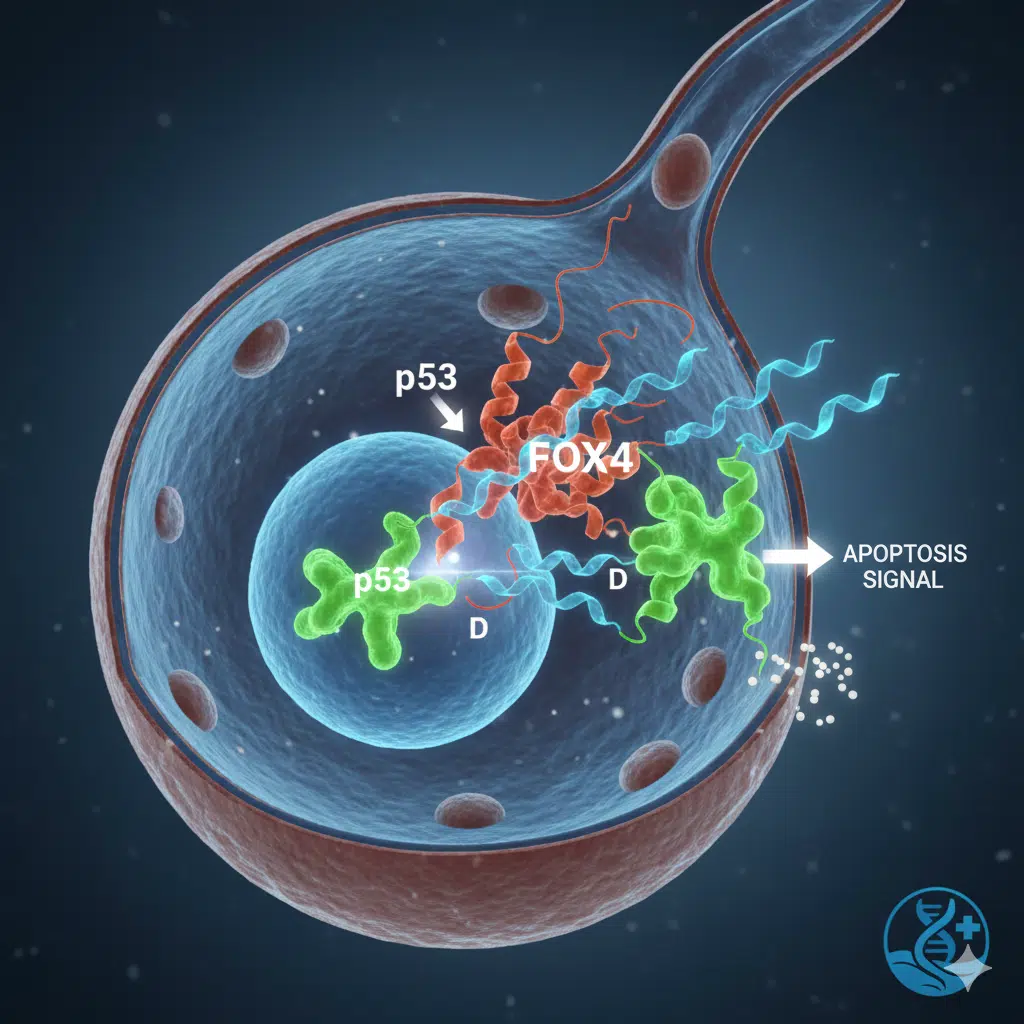
Inside a senescent cell, a protein called p53 is essentially held hostage. Scientists often call p53 the “Guardian of the Genome.” Normally, p53 would trigger the cell to self-destruct if it became damaged beyond repair. However, senescent cells produce very high levels of a protein called FOXO4.
FOXO4 binds to p53 and sequesters it. This prevents the protein from doing its job. Effectively, this is the senescent cell’s survival mechanism. Because the p53 cannot reach the DNA to signal for apoptosis, the cell survives indefinitely. This “molecular shield” is what FOXO4-DRI is designed to penetrate.
How the Peptide Releases p53
FOXO4-DRI acts as a competitive inhibitor. This means it mimics the binding site where p53 and FOXO4 usually connect. When the peptide enters the cell, it steps in between the two proteins and “frees” p53.
Once liberated, p53 can finally signal the cell to enter apoptosis. Consequently, the zombie cell clears itself out naturally. The most important result is that the inflammatory “SASP” burden on the tissue is lifted. This allows the remaining healthy cells to function without constant toxic interference.
The “DRI” Advantage: Engineering for Stability
One of the primary reasons FOXO4-DRI is a premium research compound is its D-Retro-Inverso (DRI) configuration. Standard peptides consist of L-amino acids. Unfortunately, the body’s enzymes can break these down in minutes.
To solve this, FOXO4-DRI uses “mirror-image” D-amino acids. Additionally, it reverses the sequence order. This engineering choice creates a molecule that is virtually invisible to the enzymes that would typically destroy it. Therefore, the peptide remains active in the system for a significantly longer period.
Improving Bioavailability and Targeting
Because the DRI structure resists proteolysis, it offers much higher bioavailability. This means researchers can achieve significant results with lower dosages. Furthermore, the peptide includes a “shuttle” segment that allows it to cross cell membranes effectively.
Without this targeting ability, the peptide would never reach the nucleus where p53 is trapped. However, thanks to this surgical design, FOXO4-DRI reaches the nuclear target where other compounds fail. This makes it a highly efficient tool for precision cellular research.
From the Lab: Transformative Research Results
The excitement surrounding FOXO4-DRI is not just theoretical. Instead, it is rooted in landmark studies that showed what happens when you clear “biological clutter.”
Firstly, let’s look at the 2017 Baar et al. study. Researchers observed that neutralising senescent cells in naturally aged mice led to a “visual and functional reset.” For instance, mice that had lost fur density saw a full restoration of their coat thickness. Additionally, these models showed a significant increase in physical activity levels and improved kidney function.
Metabolic and Hormonal Optimization Research
Secondly, recent research has explored the peptide’s effect on Leydig cells. These are the cells responsible for testosterone production. As these cells become senescent, hormonal output naturally drops.
However, laboratory models have shown that by clearing these dysfunctional cells with FOXO4-DRI, the remaining healthy cells can restore a more youthful hormonal environment. This suggests that the decline in testosterone associated with age may be a reversible cellular issue rather than a permanent one.
Joint Health and Tissue Integrity Studies
Thirdly, senescence is a primary driver of osteoarthritis. Senescent cells in the joints secrete enzymes that eat away at cartilage. By removing these “zombie” chondrocytes, FOXO4-DRI has shown immense promise in tissue regeneration studies.
Specifically, researchers found that clearing these cells preserved cartilage quality and reduced localized inflammation. Because of this, many labs now use FOXO4-DRI to investigate chronic joint degradation and skeletal health.
Beyond Pharmaceutical Grade: The 99.7% Purity Standard
In the peptide industry, a purity of 95% is often marketed as “pharmaceutical grade.” While this may be acceptable for simple compounds, FOXO4-DRI is a complex, 53-amino acid chain.
At 95% purity, a significant portion of the vial may consist of truncated sequences or residual reagents. These impurities can interfere with delicate cellular assays and skew your data. Therefore, the purity of the compound is not just a luxury; it is a scientific necessity for high-level research.
Why River Peptides Sets the Gold Standard
At River Peptides, we refuse to settle for the industry baseline. Our December 10th batch reached an exceptional purity of 99.7%. For the serious researcher, this near-perfect refinement provides three major benefits.
Firstly, it ensures absolute consistency. You can eliminate the “biological noise” that plagues lower-purity batches. Secondly, it guarantees maximum binding affinity. This means every molecule is structurally primed to disrupt the FOXO4-p53 complex. Finally, it protects the integrity of your data.
The Luxury of Lyophilisation
FOXO4-DRI is a sensitive molecule. Because of this, we provide it as a lyophilised (freeze-dried) powder. This state is the absolute pinnacle of peptide stability. It protects the delicate molecular structure from thermal and enzymatic degradation during transport.
Furthermore, lyophilisation makes the peptide much easier to handle in a lab setting. It creates a stable “cake” that is resistant to environmental stress. Consequently, your compound arrives in the exact same state it was in when it passed our 99.7% purity test.
Reconstitution and Solution Management
To maintain the integrity of the DRI structure, you should store the lyophilised powder at -20°C. Before you open the vial, allow it to reach room temperature. This prevents atmospheric moisture from condensing on the powder, which could degrade the peptide.
When you are ready to begin, most researchers use sterile bacteriostatic water for reconstitution. Once in solution, the peptide becomes more vulnerable. Therefore, proper storage of the liquid form is critical.
The Strategic Importance of Aliquoting
To preserve potency, you should aliquot the liquid peptide into smaller, single-use vials. Once portioned, freeze these vials immediately. This practice avoids repeated freeze-thaw cycles.
Specifically, repeated temperature changes can shear the delicate peptide chains and reduce the effectiveness of your 99.7% pure batch. By thawing only what you need for a single session, you protect your investment in high-purity FOXO4-DRI.
Summary: A New Chapter in Bio-Research
FOXO4-DRI represents a shift away from “anti-ageing” and toward true biological optimisation. By targeting the root cause of tissue dysfunction, researchers are uncovering a future where age is a manageable variable.
At River Peptides, we provide the tools for those who refuse to settle for “average” research. Our 99.7% pure FOXO4-DRI is the definitive choice for the next generation of biogerontology. Whether you are studying renal function, hormonal health, or tissue regeneration, this peptide offers a level of precision that was previously impossible.
Disclaimer: This product is sold for laboratory research purposes only. It is not intended for human consumption or therapeutic use.