Blog
Lyophilised vs Liquid Peptides: A Guide for Lab Researchers

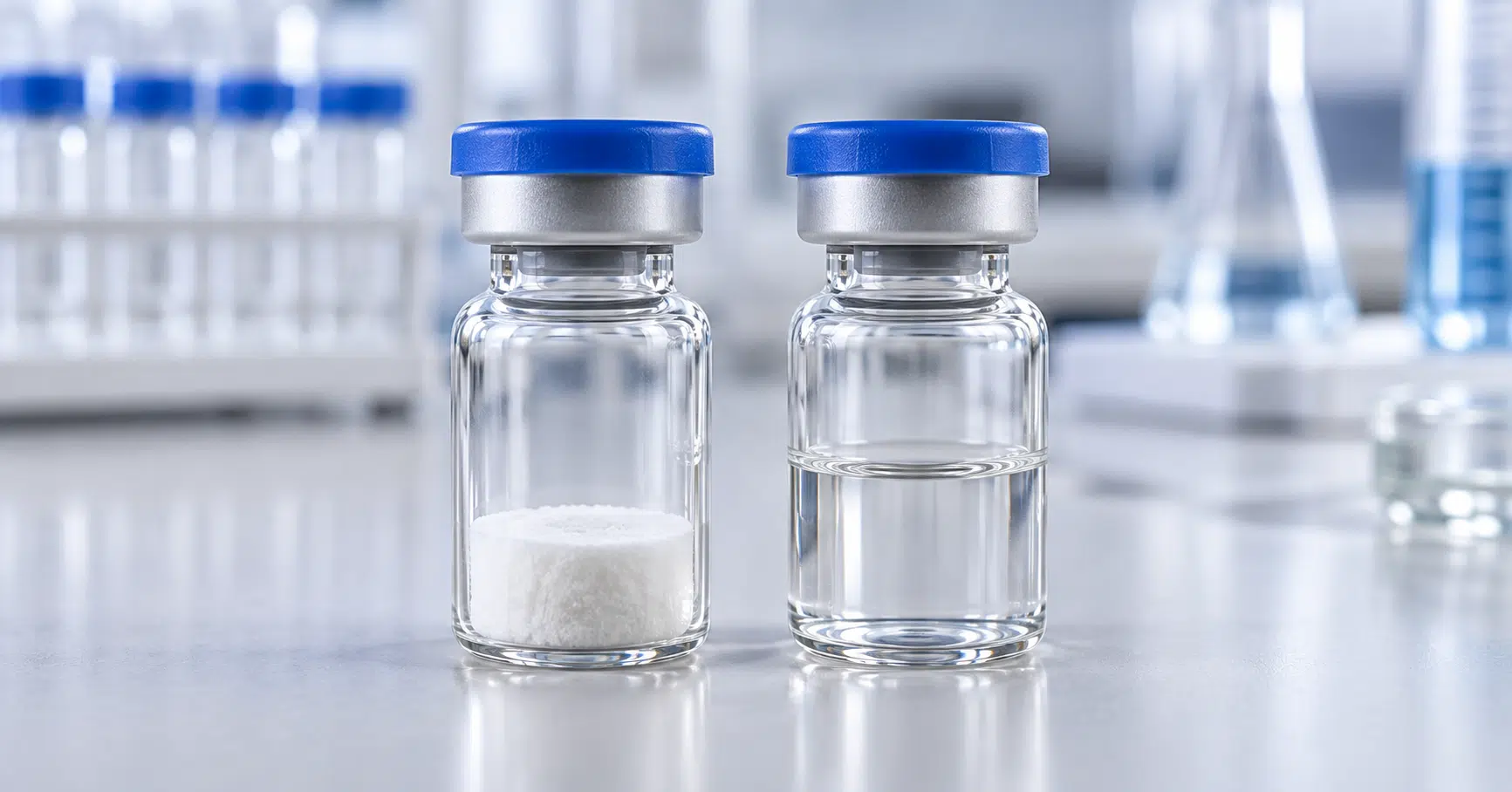
Choosing between lyophilised and liquid peptides affects how a laboratory prepares, stores and documents its research materials. Although both formats can contain the same peptide, they introduce different practical considerations before an experiment begins.
Lyophilised peptides arrive in a freeze-dried form and require dissolution before use in solution-based experiments. Liquid peptides arrive already dissolved in a specified formulation. The first format offers more control over initial preparation, while the second can reduce preparation work when its formulation suits the intended method.
Neither format is automatically purer, more suitable or more reliable. The decision depends on the peptide, supporting documentation, experimental requirements and handling conditions.
This guide compares lyophilised vs liquid peptides for lab research, explaining what to evaluate before choosing either format.
What Are Lyophilised Peptides?
Lyophilised peptides are peptide preparations that have undergone freeze-drying. The process removes much of the water from a frozen preparation under reduced pressure, leaving a dry material.
The resulting product may appear as a powder, a porous cake or a thin deposit inside the container. Its appearance alone does not establish the amount, purity or identity of the peptide.
Before a solution-based experiment, the laboratory must dissolve the material using a suitable solvent or formulation. This preparation stage is commonly called reconstitution.
Dry storage can be useful when a laboratory needs to retain material before preparing working solutions. However, freeze-drying does not make peptides indefinitely stable or remove the need for suitable storage.
Bachem’s peptide handling guidance distinguishes between dry and solution storage and explains that peptide properties vary substantially. Its recommendations support checking the individual material rather than assuming one handling method suits every peptide.
What Are Liquid Peptides?
Liquid peptides are peptides supplied already dissolved in a liquid formulation.
That formulation may include a solvent, buffer or other components. The relevant product documentation should identify the composition sufficiently for the intended research application.
“Liquid” describes the physical format. It does not, by itself, establish the concentration, purity, sterility or suitability for a particular assay.
Likewise, “ready to use” needs to be interpreted in context. A product may require no reconstitution but still need dilution, compatibility checks or analytical verification before entering an experiment.
River Peptides describes its pre-mixed peptide solutions as products supplied at a fixed concentration without a separate reconstitution stage. Researchers should still assess the formulation and dispensing format against their laboratory method.
A prepared liquid is therefore a starting material with defined characteristics, rather than an automatic substitute for every laboratory stock solution.
Lyophilised vs Liquid Peptides: Key Differences
The main differences concern preparation, formulation control and the information needed to support use.
| Consideration | Lyophilised peptides | Liquid peptides |
|---|---|---|
| Supplied form | A freeze-dried preparation. | A peptide dissolved in a formulation. |
| Initial preparation | Dissolution is required for solution-based work. | Initial dissolution has already been completed. |
| Formulation control | The laboratory can select a compatible preparation method within product requirements. | The supplied formulation is already established. |
| Concentration | The laboratory establishes its stock concentration using appropriate content information and volume. | The supplied concentration should be documented and suitable for the method. |
| Main workflow consideration | Preparation must be controlled and recorded. | Formulation compatibility must be confirmed. |
| Storage assessment | Instructions must cover the dry material and the solution prepared from it. | Instructions must cover the supplied liquid and its condition after opening. |
| Quality assessment | Batch identity, purity and relevant content information are needed. | The same information is needed, alongside relevant formulation and concentration details. |
These differences help identify what to investigate. They do not establish that one format is universally better.
Which Format Offers Better Peptide Stability?
Lyophilised preparations are often selected for storage, while peptide solutions require careful attention to their formulation and handling history. However, a useful comparison needs data relevant to the actual products being considered.
A peptide’s name is not enough to determine its stability.
Two products containing the same peptide may differ in concentration, formulation, container and storage instructions. Those differences can prevent a stability statement for one product from applying to the other.
Published peptide research recommendations for mass-spectrometry assays explicitly describe solution stability as peptide-dependent. Their scope is analytical peptide materials, so their suggested conditions should not be treated as universal shelf-life instructions for every commercial preparation.
For purchasing decisions, ask whether the available information covers the exact format supplied.
A dry peptide’s storage statement does not automatically apply after dissolution. Similarly, a prepared liquid’s expiry information may depend on whether the container remains unopened.
Why Universal Shelf-Life Claims Are Unhelpful
Statements such as “all dry peptides last two years” or “all liquid peptides expire after one month” overlook important product differences.
A meaningful shelf-life statement should identify the material, conditions and period to which it applies.
For a research laboratory, useful documentation distinguishes between unopened storage, storage after opening and storage after preparation or dilution.
Where those details are absent, seek clarification instead of filling the gap with a generic online timeframe.
Preparation Flexibility: An Advantage of Lyophilised Peptides
A lyophilised format can suit a laboratory that needs to establish its own stock formulation.
For example, a method may require a particular solvent background or a concentration that is unavailable as a commercial liquid. Starting with dry material can allow the laboratory to develop a suitable preparation, provided the peptide’s properties permit it.
That flexibility comes with responsibility.
The solvent must dissolve the peptide, support its integrity and remain compatible with the downstream experiment. Thermo Fisher’s peptide dissolution guidance identifies peptide characteristics, solvent compatibility and stability in the solvent as relevant selection criteria.
Reconstitution should therefore be treated as a defined laboratory procedure.
The preparation record should explain which material was used, which solvent was selected, how the concentration was established and how the resulting solution was stored.
River Peptides’ discussion of reconstitution mistakes provides related context for this preparation stage. The final procedure should still follow the laboratory’s method and the exact product instructions.
When This Flexibility Is Useful
Consider a laboratory developing an assay with several candidate preparation conditions.
A dry format may give the team more control over its starting formulation. It can also make it easier to document why a particular solvent was chosen.
However, that benefit depends on the laboratory having the equipment, expertise and material information needed to prepare a suitable stock.
Flexibility is valuable only when the preparation is reproducible.
Preparation Convenience: An Advantage of Liquid Peptides
A compatible liquid preparation can remove the initial dissolution step from a workflow.
This may be useful for a laboratory performing a repeated method with a consistent starting concentration and formulation. Staff can work from a defined supplied stock rather than preparing that stock independently each time.
The practical advantage is fewer preparation activities.
It does not mean that liquid products eliminate every source of error. Sample identification, dilution, transfer, storage and documentation still need control.
Before selecting a liquid product, establish whether the supplier’s formulation matches what the method requires.
If the formulation is unsuitable, the convenience of receiving a dissolved peptide may provide little benefit. A laboratory should not need to redesign an established assay simply because a particular product arrives in liquid form.
Formulation Compatibility Can Decide the Choice
A comparison based only on peptide name and price misses an important question:
What else enters the experiment with the peptide?
With a prepared liquid, the carrier formulation accompanies the material. With a dry product, the laboratory introduces a formulation during preparation.
In either case, that background should be accounted for in the experimental design.
Bachem notes that solvents and additives used to improve peptide solubility can be incompatible with some biological systems. Successful dissolution therefore does not, by itself, establish suitability for a downstream assay.
A practical review should establish whether the formulation is documented, whether the method permits its components and whether the experimental controls account for that background.
A Simple Research Example
Suppose a laboratory compares a peptide-containing sample with a control.
If the peptide sample contains a carrier component absent from the control, the comparison may introduce an additional variable.
The laboratory should resolve that issue through its method design rather than assuming the carrier has no effect.
This consideration applies to both formats. A laboratory-selected solvent needs the same scrutiny as a supplier-prepared formulation.
Purity and Concentration Are Different Measurements
When comparing lyophilised and liquid peptides, it is important to separate purity from amount.
A chromatographic purity percentage describes a result obtained using a particular analytical method. It should not automatically be interpreted as the percentage of the entire vial’s mass that consists of peptide.
Published recommendations for analytical peptides identify salt and water content as reasons why weighing a lyophilised preparation can be insufficient for establishing peptide amount accurately.
For quantitative work, the laboratory should understand what the stated quantity represents and how it was determined.
The same principle applies to a prepared solution. A concentration claim should have a clear basis, especially where accurate quantification is central to the experiment.
Questions to Ask About a Dry Product
Clarify whether the stated amount represents gross material, nominal peptide quantity or an analytically established peptide content.
Also establish whether the documentation contains the information required by the laboratory’s concentration calculations.
Questions to Ask About a Liquid Product
Confirm the stated concentration, its units, the supplied volume and the basis for the concentration claim.
If the experiment requires a verified concentration, determine whether suitable analytical evidence is available.
Neither a high purity claim nor a convenient format resolves these questions automatically.
Does Lyophilisation Make a Peptide Purer?
Lyophilisation is a drying process. It should not be treated as proof that a product has higher purity than a liquid alternative.
Likewise, supplying a peptide in solution does not inherently establish lower purity.
The relevant evidence comes from appropriate testing and documentation for the material being supplied.
River Peptides’ batch-specific testing page describes HPLC and mass-spectrometry testing, with certificates linked to product batch identifiers. Those records provide a basis for assessing the tested material rather than inferring quality from its physical form.
When comparing products, make sure the certificate corresponds to the relevant batch and understand what sample was analysed.
For a formulated liquid, it is particularly useful to establish whether the available evidence concerns the starting peptide, the finished preparation or both.
Storage and Handling Require Different Records
The format influences which events need to be recorded during laboratory handling.
For lyophilised peptides, the material history should cover receipt, dry storage, opening and preparation. Once a solution is made, the laboratory has a new handling stage to document.
For liquid peptides, the record begins with the supplied formulation and should cover receipt, opening, transfers and any subsequent dilution.
The objective is to make the material’s history understandable to someone reviewing the experiment later.
Moisture and Dry Material
A dry preparation still requires suitable protection.
Merck’s peptide guidance identifies moisture exposure as a concern for lyophilised peptide stability. It also describes allowing a cold, sealed vial to equilibrate before opening during preparation to reduce condensation. This should be applied within the product’s handling instructions rather than interpreted as a reason to leave deliveries at room temperature.
Freeze-Thaw Handling
Repeated freezing and thawing is another consideration for peptide solutions. Thermo Fisher advises avoiding repeated cycles in its custom peptide guidance.
That advice does not mean every commercial liquid should be frozen.
Follow the conditions supported for the actual product. Any aliquoting or storage procedure should be suitable for the formulation and the intended method.
Do Liquid Peptides Always Need Cold-Chain Shipping?
Shipping requirements should be established from product-specific information.
The distinction between dry and liquid is relevant, but it does not provide a complete transport specification.
A suitable review asks what temperatures are permitted during transport, what journey duration is supported and what should happen if the delivery is delayed.
It also separates transport conditions from long-term storage requirements.
For either format, the receiving laboratory should be ready to inspect the delivery and transfer the material into its specified storage promptly.
If a shipment arrives under questionable conditions, document the issue and request an assessment. The appearance of the material alone cannot establish whether the journey was acceptable.
Which Format Supports Better Reproducibility?
Either format can support a reproducible workflow when the relevant variables are controlled.
With lyophilised peptides, the laboratory needs a consistent preparation procedure. With liquid peptides, it needs confidence that the supplied formulation and concentration suit the method and remain consistent across the materials used.
A useful comparison focuses on where uncertainty enters the workflow.
| Research situation | Main issue to resolve |
|---|---|
| Several staff prepare stocks independently. | Can preparation be standardised and documented? |
| A supplied liquid is used across repeated experiments. | Is its formulation suitable and consistently specified? |
| Quantitative results depend on precise peptide amount. | Is concentration supported by an appropriate measurement? |
| Material is retained across a long study. | Are storage duration and handling conditions supported? |
| A new batch replaces an existing batch. | What checks are needed before continuing the study? |
The format should support the method’s requirements and the laboratory’s ability to control them.
Comparing Cost Beyond the Purchase Price
A useful cost comparison includes the work required to obtain material suitable for the planned experiment.
For a dry product, that may include preparation time, compatible reagents, consumables and any concentration verification required by the method.
For a liquid product, it may include compatibility checks, shipping arrangements and the amount that can be used within its supported handling period.
A lower purchase price does not necessarily mean a lower cost per completed experiment.
For example, a liquid formulation that cannot be used in the intended assay has little practical value to that project. Equally, a dry preparation that requires substantial method development may introduce work that the laboratory did not anticipate.
The comparison should reflect the actual workflow rather than the price of the container alone.
How to Choose the Right Peptide Format
Begin with the experimental requirements and assess each available product against them.
Define the Required Starting Material
Establish the peptide identity, relevant specifications, concentration requirements and permitted formulation components.
Avoid beginning with a preferred format and then trying to make the method fit it.
Review the Available Documentation
Check the batch information, analytical results, quantity or concentration basis, storage instructions and relevant formulation details.
Record questions that remain unanswered.
Assess Preparation Capability
Determine whether the laboratory can prepare and document a suitable stock from dry material.
For a liquid, determine whether the supplied formulation can enter the workflow without introducing uncontrolled variables.
Plan Storage and Use
Consider how much material will be used, how often it will be accessed and whether the supported storage period fits the study.
A purchasing quantity should make sense for the planned work.
Confirm Suitability Before Routine Use
Where the material is critical to the method, establish an appropriate acceptance process before committing it to a larger study.
That process should address the experiment’s actual risks and requirements.
Frequently Asked Questions
What is the main difference between lyophilised and liquid peptides?
Lyophilised peptides arrive as a freeze-dried preparation that requires dissolution for solution-based experiments. Liquid peptides arrive already dissolved in a formulation. The main practical differences involve preparation, formulation control and handling requirements.
Are lyophilised peptides always better for research?
No. They can be useful when a laboratory needs control over initial preparation, but a compatible liquid may better suit a repeated workflow. Suitability depends on the method and supporting product information.
Are liquid peptides less pure?
Their liquid form does not establish their purity. Compare relevant analytical results for the products and batches rather than inferring quality from the format.
Does ready to use mean ready for every assay?
No. It may mean that reconstitution is unnecessary. The laboratory still needs to establish whether the formulation, concentration and container format suit its intended procedure.
Can the same storage instructions be used before and after reconstitution?
They should not be assumed to apply. Dry material and the solution prepared from it represent different storage conditions. Obtain instructions relevant to each stage.
Do all peptides dissolve in water?
No. Peptide properties influence solvent selection. A suitable preparation must also account for the downstream application, so a universal solvent instruction is inappropriate.
Does a high purity percentage confirm the amount in a vial?
Not by itself. Purity, peptide content and concentration address different questions. Quantitative work requires a clear understanding of the quantity claim and its analytical basis.
Can a laboratory switch between formats during a study?
A change of format should be assessed before implementation. Review formulation, concentration, preparation and documentation requirements, then determine what method checks are needed to support the change.
Choosing a Format That Fits the Research
Lyophilised peptides can give laboratories greater control over initial preparation. Liquid peptides can reduce preparation work when the supplied formulation matches the method.
The strongest choice is the one supported by suitable batch information, clear handling instructions and a workflow the laboratory can reproduce.
Evaluate the complete research material, including its formulation and documentation, rather than choosing on physical format alone.
This article concerns laboratory research materials and does not provide instructions for human or veterinary use.