Blog
How Freeze-Thaw Cycles Affect Peptide Stability in Research

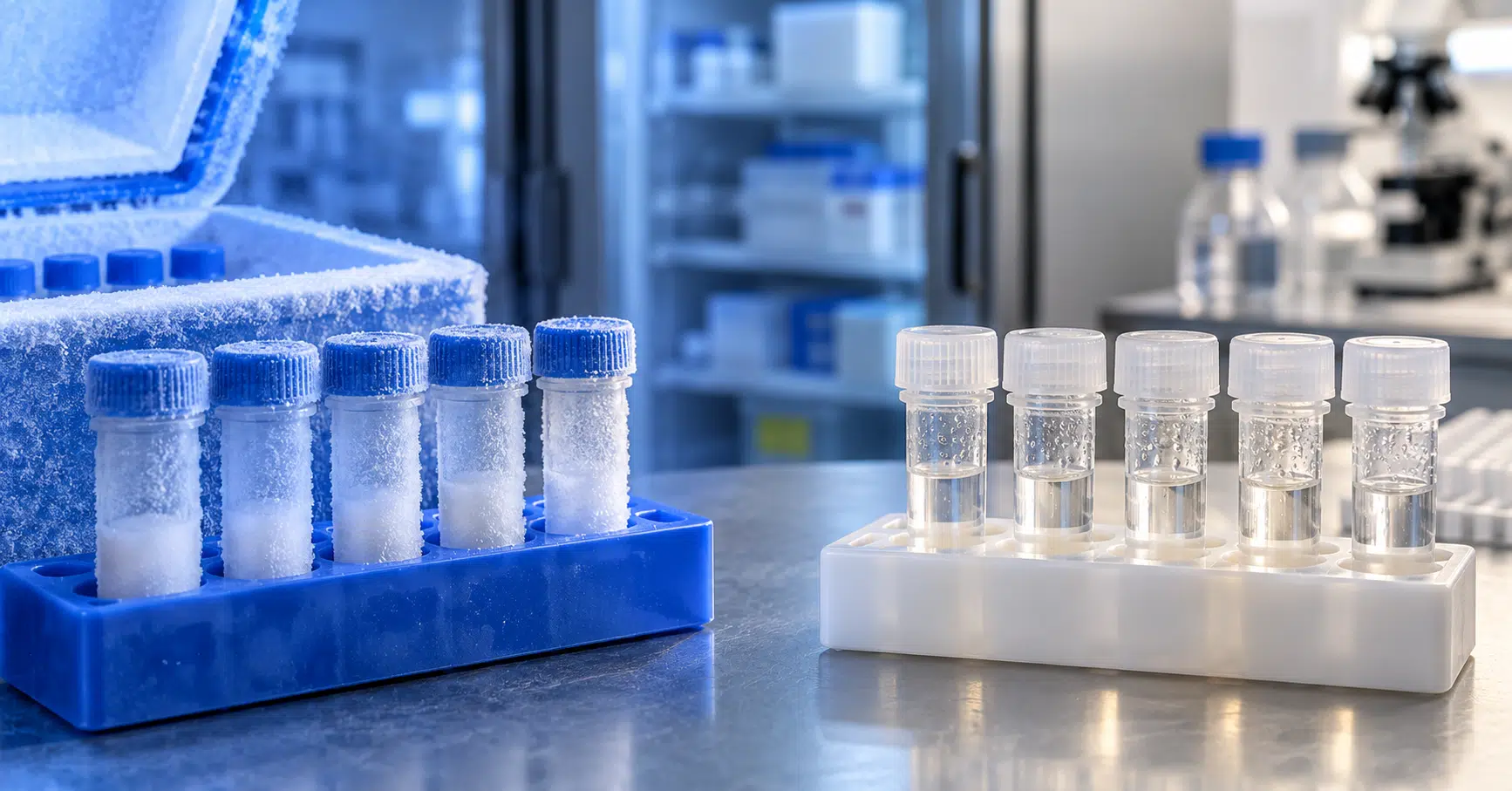
A peptide stock can spend most of its life in a freezer and still develop a complicated handling history. Each time the container is removed, thawed, sampled and returned to storage, the material experiences another change in conditions.
Those changes can matter for laboratory research.
Freeze-thaw cycles may affect peptide solubility, recovery or chemical integrity, depending on the peptide and its formulation. They can also introduce variability that makes results harder to reproduce. However, one cycle does not automatically destroy a peptide, and there is no universal number of cycles that every peptide can tolerate.
Understanding freeze-thaw stability requires looking beyond the freezer temperature. The formulation, container, concentration, thawing procedure and time spent outside storage all contribute to the assessment.
This guide explains what freeze-thaw cycles are, why they can affect research materials and how laboratories can manage them without relying on unsupported storage rules.
What Is a Freeze-Thaw Cycle?
A freeze-thaw cycle involves a solution freezing and subsequently thawing back into a liquid.
In laboratory records, teams should define how they count cycles. For example, a procedure might count each thaw of a previously frozen aliquot as one cycle and record any subsequent refreezing separately.
The important point is consistency. A handling record should make it clear what actually happened to the material.
Repeated cycling commonly occurs when a laboratory stores a large stock in one container and removes small amounts over several working sessions. The remaining stock may then experience multiple freezing and thawing events.
Partial thawing also deserves attention. A sample does not need to become completely liquid for its temperature history to depart from a defined storage procedure.
Freeze-Thaw Exposure Is Different From Frozen Storage
A sample held continuously under supported frozen conditions has a different history from one repeatedly brought out for use.
Both may have the same preparation date and nominal storage temperature, yet their handling records can be very different.
This distinction matters when comparing experimental results or investigating a change in analytical response.
“Stored frozen” is useful information, but it does not describe how often the stock was accessed.
Why Can Freezing Change a Peptide Solution?
Freezing does more than lower temperature. It changes the physical environment within a solution.
The effects depend on the formulation and the conditions under which freezing occurs. These mechanisms should be treated as possible contributors to instability, not proof that every peptide is damaged whenever ice forms.
Solutes Can Become Concentrated During Freezing
As ice forms in an aqueous solution, dissolved components can become concentrated in the remaining unfrozen liquid.
This means parts of the sample may temporarily experience a different local environment from the original solution.
Experimental research on frozen aqueous peptide-synthesis systems has demonstrated the importance of this freeze-concentration effect. That work helps explain why freezing should not be viewed simply as preserving an unchanged liquid at a lower temperature. It does not establish a degradation rate for unrelated peptide products.
Some Buffer Systems Can Undergo pH Changes
The pH measured before freezing does not necessarily describe conditions throughout the freezing process.
Research on sodium phosphate buffers found that selective salt precipitation during freezing could cause substantial pH changes. The behaviour depended on buffer composition and experimental conditions.
For peptide research, the practical implication is that the buffer is part of the stability question.
A handling recommendation established in one formulation should not automatically be transferred to another formulation containing the same peptide.
Freezing Creates New Interfaces
Freezing produces boundaries between ice and the remaining liquid.
Studies of proteins show that these interfaces can contribute to instability under some conditions. However, protein findings cannot be assumed to predict the behaviour of every short peptide. Molecular structure and formulation matter.
It is therefore inaccurate to describe ice crystals as automatically “breaking peptide chains”. The relevant changes require evidence for the material being studied.
What Can Change After Repeated Freeze-Thaw Cycles?
Several different observations may arise during a stability assessment.
A laboratory might detect a change in soluble peptide recovery, an altered chromatographic profile, visible precipitation or increased variability between measurements.
These observations are not interchangeable.
For example, reduced analytical signal could reflect less material reaching the instrument. It does not automatically establish chemical degradation. Likewise, a clear solution does not establish that its chemical composition is unchanged.
| Observation | Possible significance | What it does not prove alone |
|---|---|---|
| Visible particles or cloudiness appear. | The physical state of the preparation may have changed. | The identity or amount of any degradation product. |
| The measured peptide response decreases. | Recovery, concentration or analytical behaviour may have changed. | That freeze-thaw exposure was the sole cause. |
| Additional chromatographic peaks appear. | The sample may contain newly detectable components. | Their identities without further assessment. |
| Replicate measurements become more variable. | The workflow or material may be less consistent. | A specific molecular mechanism. |
| No visible change occurs. | No obvious macroscopic change was observed. | That the material retained all relevant properties. |
A useful investigation separates what was observed from what is being inferred.
What Does Peptide Research Show?
Published recommendations for peptides used in mass-spectrometry assays include experimental comparisons of storage conditions.
In that work, variability in peptide peak area was sequence-dependent, and the highest variability occurred after ten freeze-thaw cycles under the conditions studied. This supports concern about repeated cycling in analytical workflows.
However, it does not mean ten cycles represent a universal failure point, or that fewer cycles are always acceptable. The result belongs to the tested peptides, formulations and methods.
Supplier guidance also commonly recommends reducing unnecessary cycling. Bachem advises dividing suitable peptide solutions into aliquots before freezing to avoid repeated thawing and refreezing, while noting that solution stability depends on factors including solvent and pH.
Together, these sources support a practical approach: minimise avoidable exposure and use product-specific evidence to establish acceptable handling.
How Many Freeze-Thaw Cycles Can a Peptide Tolerate?
There is no reliable universal answer.
A claim such as “three cycles are safe” needs evidence for the actual material and intended use. Without that evidence, the number is an assumption.
An acceptable cycle limit may depend on the peptide sequence, formulation, concentration, container, freezing conditions and analytical requirements.
It also depends on what the laboratory means by stability.
A preparation might meet one analytical criterion while failing another. A method concerned with precise quantification may require different acceptance criteria from a preliminary qualitative experiment.
Why Cycle Count Alone Is Incomplete
Consider two hypothetical stocks that have each been thawed twice.
The first was handled briefly under a defined procedure. The second remained outside its specified storage conditions for an extended period during each use.
Their cycle counts match, but their exposure histories do not.
Useful records should therefore capture the relevant handling conditions alongside the count.
Does One Cycle Automatically Make a Peptide Unusable?
No.
Some products are explicitly intended to be stored frozen and thawed before use. Their instructions may still discourage or prohibit refreezing.
For example, Thermo Fisher’s AQUA peptide handling instructions describe frozen storage for specified peptide solutions and advise against repeated cycling. Those instructions apply to those products and formulations, rather than all commercial peptide liquids.
The correct decision comes from applicable instructions and stability evidence, not a blanket rule that all freezing is harmful.
Lyophilised Peptides and Liquid Peptides Need Different Assessments
A sealed lyophilised preparation and a peptide dissolved in liquid do not present the same handling problem.
A dry product does not contain a bulk aqueous phase undergoing the same ice formation as a solution. However, repeated temperature changes and opening procedures can still affect its handling conditions, particularly where moisture exposure occurs.
General peptide guidance from Merck recommends avoiding repeated temperature cycling and gives separate considerations for dry material and solutions.
Once a lyophilised peptide is dissolved, the laboratory should use instructions appropriate to the resulting solution.
Prepared Liquids Require Formulation-Specific Instructions
A prepared liquid should not be frozen simply because another product with the same peptide name is stored that way.
River Peptides’ pre-mixed peptide solutions represent a different starting format from dry material prepared within a laboratory. Their suitability for freezing must be established from the relevant product instructions.
If the supplied documentation does not support frozen storage, do not introduce it as an assumed preservation method.
Why Aliquoting Can Reduce Repeated Exposure
Aliquoting means dividing a stock into smaller, separately identified portions.
Where the formulation permits frozen storage, appropriately sized aliquots can reduce the need to thaw the main stock repeatedly.
Instead of accessing one large container for every experiment, the laboratory can select the portion needed for a defined session.
This approach is reflected in peptide handling guidance from manufacturers including R&D Systems, which recommends aliquots to avoid repeated freeze-thaw exposure for its peptide solutions.
Aliquot Size Should Fit the Workflow
There is no universal aliquot volume.
The appropriate size depends on the planned experiment, transfer method, concentration and expected consumption.
An aliquot that is much larger than the working requirement may recreate the original problem if it is repeatedly refrozen. Very small portions may introduce additional transfer and handling challenges.
The goal is a practical balance supported by the laboratory’s method.
Aliquoting Introduces Its Own Handling Step
Dividing a stock is not automatically loss-free.
Waters identifies adsorption to containers and incomplete re-solubilisation as possible sources of peptide loss during sample preparation. This is a reason to assess the suitability of containers and transfers rather than assuming any tube will perform identically.
A suitable aliquoting procedure should therefore specify the container, labelling and handling method, not just the volume.
Container Choice Can Affect Peptide Recovery
A change in measured peptide response is not always caused by chemical breakdown.
Some peptides can interact with surfaces during sample handling. Waters describes non-specific binding to solid surfaces as a relevant issue in peptide bioanalysis.
This matters when a freeze-thaw investigation also changes the sample container.
For example, comparing a freshly prepared stock in one vessel with a thawed aliquot in a different vessel introduces more than one variable.
If the measured response changes, the laboratory needs a way to distinguish temperature-history effects from container-related recovery differences.
For critical quantitative work, container suitability should be considered alongside the storage procedure.
A Practical Workflow for Managing Freeze-Thaw Exposure
A useful handling procedure should be specific enough that different staff can follow it consistently.
Confirm the Product Instructions
Before placing a peptide solution in frozen storage, establish whether freezing is supported for that product or laboratory formulation.
Record any restrictions on thawing, refreezing and the period after opening.
When the instructions are unclear, obtain clarification before designing the storage workflow.
Define the Starting Preparation
Record the peptide identity, batch, formulation, concentration basis and preparation date.
Freeze-thaw history becomes difficult to interpret when the starting solution is poorly documented.
Related reconstitution mistakes can also introduce uncertainty before storage begins, making it important to assess preparation and subsequent handling separately.
Plan Access Before Freezing
Estimate how much material each working session requires.
Where supported, prepare suitable portions so the remaining stock does not need to be accessed unnecessarily.
Keep a record linking each portion to the original preparation.
Standardise Thawing and Mixing
Use a procedure appropriate to the product and laboratory method.
Avoid improvising a faster thawing method or adding heat simply because the sample is taking longer than expected. A change in the procedure should be assessed before routine use.
Where the method requires a homogeneous solution before sampling, define how that condition is established.
Record What Happens After Thawing
Document when the material was thawed, its relevant handling conditions and its disposition.
If refreezing is permitted, record it. If the instructions prohibit refreezing, manage the unused portion accordingly.
A clear record is more useful than relying on memory or an unlabelled mark on the container.
What Should a Peptide Handling Record Include?
The level of detail should match the experiment, but the record needs to connect the material with its preparation and storage history.
| Record field | Purpose |
|---|---|
| The product and batch identifier are recorded. | This connects the material to its source documentation. |
| The formulation and concentration basis are identified. | This establishes what was placed into storage. |
| The preparation and aliquoting dates are recorded. | This provides a timeline for the stock and its portions. |
| The storage conditions are specified. | This shows the conditions intended for the material. |
| Each relevant thawing event is documented. | This distinguishes continuous storage from repeated access. |
| Deviations and decisions are recorded. | This explains how unusual events were assessed. |
Such records help researchers investigate inconsistent results without assuming that freeze-thaw exposure was necessarily responsible.
Can a Certificate of Analysis Confirm Freeze-Thaw Stability?
A certificate of analysis describes the testing represented by that document.
It does not automatically establish that a peptide will remain suitable after repeated cycling in a different formulation or container.
River Peptides’ batch-specific testing provides a way to connect products with analytical information. That evidence should be considered alongside the laboratory’s handling history.
If freeze-thaw tolerance is important to the method, ask whether the available documentation includes a relevant stability assessment.
The key distinction is between a material meeting analytical specifications at testing and a material remaining suitable after a defined handling procedure.
Both questions matter, but they require different evidence.
How Laboratories Can Assess Freeze-Thaw Stability
A laboratory may need its own assessment when repeated exposure is unavoidable or when supplier information does not cover the intended workflow.
The study should answer a defined question. For example:
Does the proposed handling procedure preserve the characteristics required by this analytical method?
It should not attempt to establish a universal rule for the peptide under every possible condition.
Use Comparable Starting Material
Samples should come from a suitably consistent starting preparation.
If formulation, concentration or container differs between groups, the interpretation becomes more difficult.
Define the Exposure Conditions
Specify what counts as a cycle, how the sample is frozen and thawed, and how long it spends under relevant conditions.
The study should represent the proposed laboratory workflow closely enough to support a practical decision.
Include an Appropriate Comparator
A comparator helps distinguish cycling effects from changes associated with elapsed storage time or analytical variability.
The choice of comparator should fit the study design and the stability question being asked.
Select Meaningful Measurements
The measurements should address the characteristics important to the experiment.
Depending on the method, that may involve quantitative recovery, chromatographic changes, identity-related analysis or physical observations.
No single measurement should be assumed to detect every possible change.
Set Acceptance Criteria Before Reviewing Results
Decide what constitutes an acceptable difference before analysing the outcome.
The conclusion should identify the conditions actually tested. Demonstrating acceptable results under one procedure does not validate every other concentration, container or formulation.
What to Do After an Accidental Freeze-Thaw Event
An unexpected event should trigger documentation and assessment.
Record what is known about the product, formulation, temperature history, duration and prior handling. Inspect the container for damage and preserve relevant evidence.
Maintain the material according to applicable instructions while seeking guidance. Avoid introducing additional freezing or warming in an attempt to reverse an unknown change.
Where the exposure falls outside supported conditions, keep the affected material identifiable while its suitability is assessed.
The decision should reflect the intended experiment and available evidence. Neither “it looks clear” nor “it was frozen once” provides a complete acceptance decision.
Common Misunderstandings
“Every Cycle Destroys a Fixed Percentage”
There is no universal percentage loss per cycle. Such a claim requires measurements for the relevant peptide, formulation and handling procedure.
“Returning It to the Freezer Resets Stability”
Refreezing does not erase the sample’s previous exposure history.
Any decision to refreeze should follow applicable instructions rather than being treated as an automatic recovery step.
“A Clear Solution Must Be Unchanged”
Visual inspection can identify some obvious problems. It cannot establish chemical integrity or accurate concentration.
“Every Peptide Behaves Like a Large Protein”
Evidence from protein formulations can explain possible mechanisms, but it does not predict the response of every peptide.
“Colder Storage Is Always Better”
Storage should match the documented requirements. A colder temperature is not automatically appropriate for a supplied formulation.
Frequently Asked Questions
Can freeze-thaw cycles affect peptide stability?
Yes. Repeated cycling can affect the physical or chemical behaviour of some peptide preparations and may increase analytical variability. The outcome depends on the material and conditions.
How many times can a peptide solution be frozen and thawed?
There is no universal acceptable number. Follow product-specific instructions or a relevant laboratory stability assessment.
Should all peptide solutions be stored frozen?
No. Some preparations support frozen storage, while others may have different requirements. Do not apply generic freezing advice to every liquid product.
Does aliquoting guarantee stability?
No. It can reduce repeated access to the same stock, but formulation, container suitability, storage conditions and handling still matter.
Is a lyophilised peptide affected in the same way as a solution?
No. A dry preparation does not undergo the same bulk-liquid freezing process. It still requires appropriate handling, particularly to manage moisture exposure.
Can HPLC alone prove that repeated thawing caused no change?
The conclusion depends on the method and the characteristics being assessed. One analytical result should not be assumed to establish every aspect of stability.
What if a peptide was accidentally thawed once?
Document the event and compare it with the applicable handling instructions. A single thaw is not automatically a failure, but its acceptability should be supported for the product and intended use.
Managing Stability Through Consistent Handling
Freeze-thaw exposure is one part of a peptide’s laboratory history.
The most useful approach is to establish suitable storage conditions, minimise unnecessary cycling and record how the material is used. Where uncertainty matters to the experiment, assess it using a defined procedure and relevant measurements.
Product-specific instructions and reproducible handling provide a stronger basis for research than a universal cycle limit.
This article concerns laboratory research materials and does not provide instructions for human or veterinary use.