Blog
Peptide Pens vs Cartridges for Laboratory Research

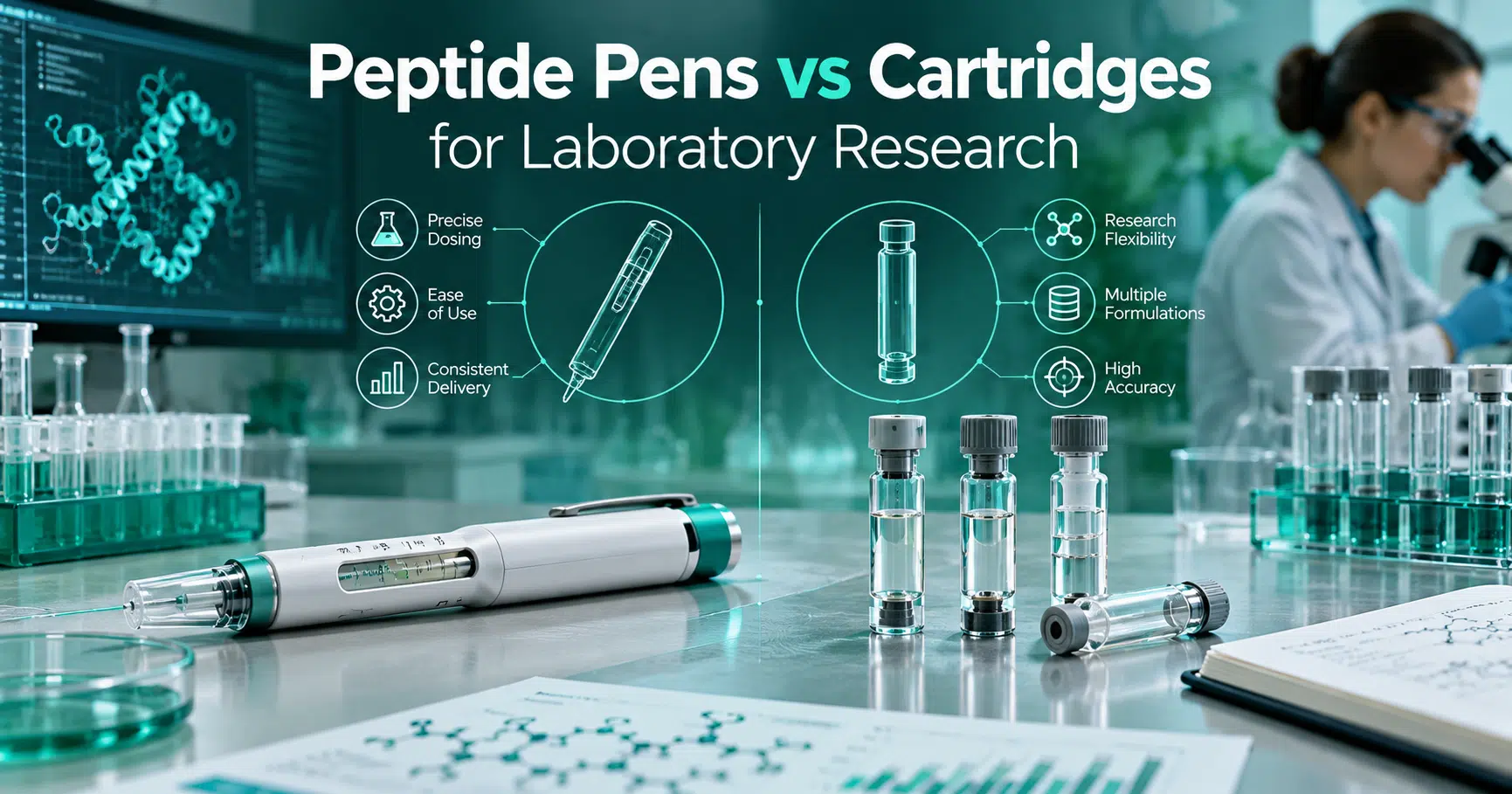
Peptide pens and cartridges are related components, but they are not interchangeable terms. A pen is a dispensing device or an assembled system. A cartridge is the container that holds material and may be designed to work with a specified device.
For laboratory research, this distinction determines what needs to be documented and tested. Chemical information about the contents does not establish the performance of the pen mechanism, while device specifications do not confirm the identity or concentration of the peptide.
A useful comparison separates three questions: what material is supplied, what container holds it and what device is used to dispense it.
What Is the Difference Between a Pen and a Cartridge?
A pen may be supplied as a prefilled assembly or as a device intended to accept a compatible cartridge. The exact arrangement depends on the product.
A cartridge is a primary container. Its dimensions, closure components and intended device pairing are part of its specification. A cartridge supplied separately does not necessarily include a dispensing mechanism.
This means “pen versus cartridge” is not always a comparison between two alternative peptide preparations. In some cases, the cartridge is already part of the pen system being evaluated.
Before comparing listings, identify whether each item is a complete assembly, an empty device, a filled cartridge or another configuration. A product image or short title may not provide enough detail.
Define the Laboratory Purpose Before Choosing a Format
If the experiment concerns the peptide’s chemical properties, the main requirements may include identity, purity, measured content and formulation composition. A dispensing device may add variables without contributing to the research question.
If the experiment concerns container compatibility or dispensing performance, the pen and cartridge combination becomes part of the object being studied. Device model, cartridge specification and test conditions then need to be recorded.
Neither configuration should be treated as an established laboratory tool solely because it is marketed for research. Its suitability depends on the available evidence and the requirements of the particular study.
Physical Fit Does Not Establish Compatibility
A cartridge fitting inside a device is not sufficient evidence that the combination will function as intended.
Relevant questions can include whether the device is specified for that cartridge, whether the closure components are compatible with the mechanism and whether performance has been evaluated with the supplied formulation.
A laboratory should request a documented compatibility statement for the exact pairing. Similar appearance, shared nominal capacity or an informal description such as “universal” should not replace that evidence.
Where compatibility information is unavailable, record the uncertainty. Do not treat an unverified pairing as equivalent to a documented system.
Separate Peptide Quality from Device Performance
A peptide report and a dispensing assessment answer different questions.
Chemical testing can provide evidence about the identity, purity or content of a submitted sample. A device assessment examines matters such as the consistency of output under defined conditions.
One cannot be inferred from the other. A chemically well-characterised solution could be dispensed inconsistently, and consistent liquid output would not establish the solution’s chemical identity.
The review should therefore identify which claims are supported by which documents. Avoid allowing a general “tested” description to cover several properties that were never measured.
Device Markings Do Not Independently Establish Peptide Amount
Numbers or settings on a device should not automatically be interpreted as a measured peptide mass.
The amount of peptide in a collected sample depends on the actual solution concentration and the recovered volume, together with any relevant losses. The meaning and performance of device settings need to be established for the specific system.
For laboratory work that depends on quantitative collection, assess whether the evidence covers the intended operating conditions and the formulation being studied. Do not assume that data from a different cartridge or solution transfers directly.
This is a measurement question, not an instruction for administering the contents.
Check What the Certificate of Analysis Represents
An analytical report may refer to starting material, a prepared solution or a sample from a filled cartridge. Researchers need to know which stage was sampled.
A result obtained before formulation does not independently establish the concentration after filling. Similarly, a report for one peptide batch does not automatically demonstrate the performance of every device assembled with it.
Useful documentation should allow the laboratory to connect the material batch, formulation or filling record, cartridge identification and relevant device information. Where one of those links is missing, seek clarification before treating the records as a complete account of the supplied system.
Our guide to what researchers should check before buying peptides explains the broader documentation review that should accompany a purchase.
Storage Evidence Must Match the Supplied Presentation
Storage information should relate to the actual formulation and container system. Evidence for a dry peptide does not automatically establish the stability of a prepared cartridge.
Researchers should distinguish between conditions before opening, after the system enters use and during any laboratory evaluation. Record the relevant dates and handling conditions instead of applying a generic storage period across products.
Where the study could be affected by container interactions, leakage or microbial quality, request the relevant evidence separately. A purity result does not resolve those questions.
Build a Clear Comparison Record
A practical assessment can document the following information for each option:
- Whether the supplied item is a device, cartridge or complete assembly.
- The peptide identity and disclosed formulation.
- The material and filled-product batch identifiers.
- The exact device and cartridge compatibility information.
- The chemical tests performed and the sample stage tested.
- The evidence supporting quantitative dispensing, if required.
- The storage conditions applicable to the supplied presentation.
This record helps reveal whether two products can be compared fairly. It also gives future researchers a clearer account of the system used during the experiment.
River Peptides: Traceability, Testing and ISO Standards
Researchers reviewing pen or cartridge options can consult the River Peptides quality testing page for the supplier’s stated testing process. The relevant batch report should be assessed alongside any separate formulation, compatibility and device-performance information.
ISO 9001 provides a quality-management framework, and ISO 14001 addresses environmental management. When reviewing ISO certification, verify the organisation and activities covered. Certification does not independently validate a particular pen and cartridge combination.
All products are supplied strictly for laboratory and in vitro research purposes. They are not intended for human or veterinary use.
Frequently Asked Questions
Is a cartridge the same thing as a peptide pen?
No. A cartridge holds the material, while a pen provides a dispensing mechanism or complete assembly. Some pens contain a cartridge as part of their design.
Can cartridges be exchanged between different pen models?
Compatibility should not be assumed. Use documentation that identifies the exact cartridge and device pairing.
Does a peptide Certificate of Analysis verify the whole device?
Only the properties and sample identified in the report are supported by that report. Chemical analysis alone does not establish device compatibility or dispensing performance.