


CJC-1295 without DAC
Price range: £27.99 through £49.99 inc. VAT
Select options
This product has multiple variants. The options may be chosen on the product page


Providing trusted compounds for research into metabolism, muscle biology, and recovery — supporting innovation with quality and precision.
Providing trusted compounds for research into metabolism, muscle biology, and recovery — supporting innovation with quality and precision.
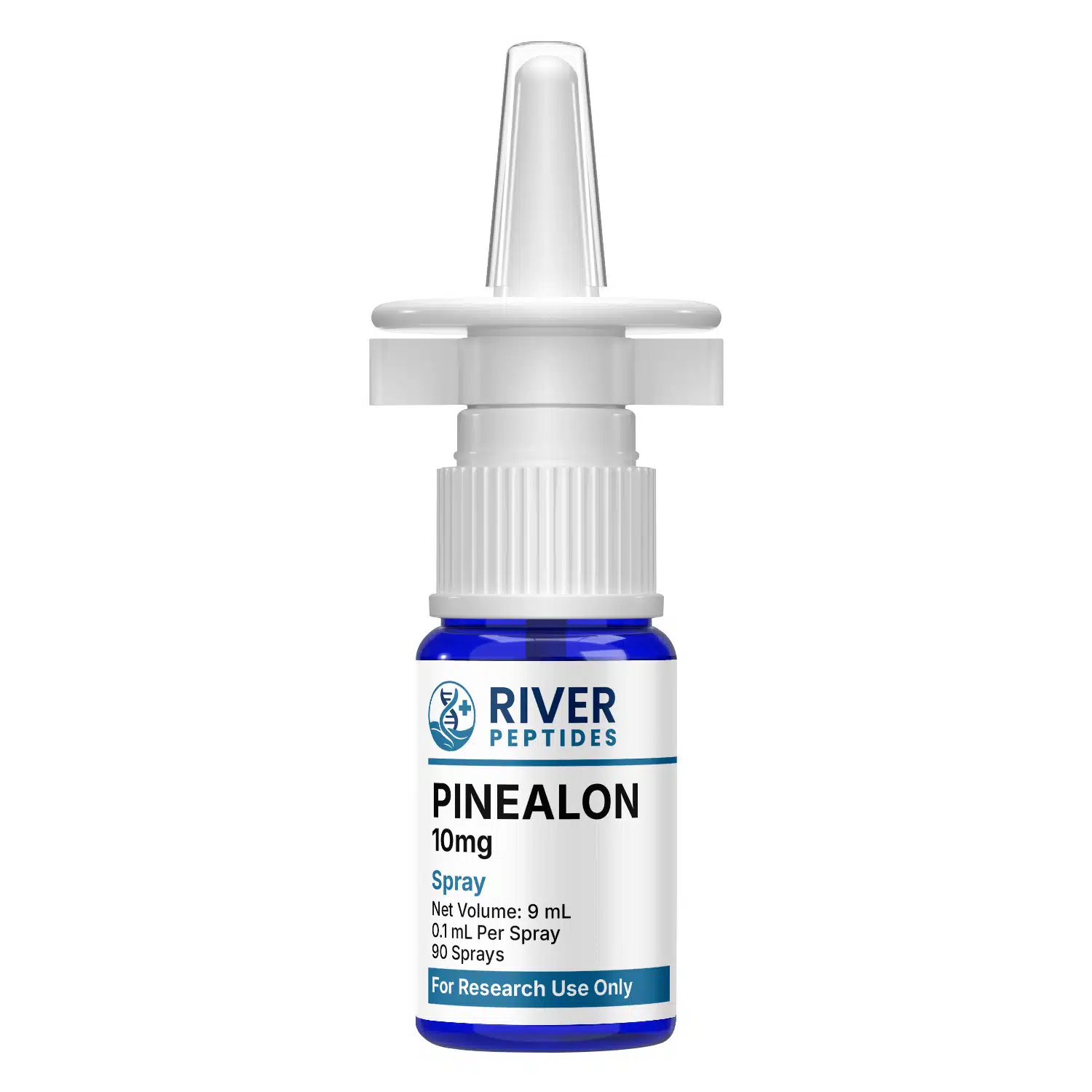
Pinealon (10mg) — Research Compound
Pinealon is a synthetic tripeptide research compound derived from the pineal gland’s regulatory proteins. It is studied for its ability to cross the blood-brain barrier and interact with the circadian rhythm and neuronal protein synthesis pathways. Researchers investigate Pinealon for its potential to modulate cellular ageing within the central nervous system and its role in protecting neurons from oxidative stress-induced damage.
Findings from early-stage clinical trials have reported:
Researchers study Pinealon to explore its utility in supporting neuro-regeneration and biological clock synchronisation. By focusing on the peptide’s interaction with DNA methylation and protein expression, it serves as a valuable tool for investigating longevity and the mitigation of age-related cognitive decline. Its unique ability to penetrate the blood-brain barrier makes it a focal point for research into central nervous system stability.
Available Formats:
This compound is available in a 9ml premixed spray bottle, providing a stable solution for precise administration in research settings.
Used solely for in vitro experiments and cannot be:
Pinealon peptide and neuronal gene expression regulation
This review discusses Pinealon as a short peptide bioregulator studied for neuronal gene expression and ageing-related cellular pathways.
Source Link: Available here
Peptide bioregulators and brain tissue ageing research
Researchers examined Pinealon and related peptides for their potential role in regulating neuronal cellular function.
Source Link: Available here
The role of short peptides in neural tissue homeostasis
This publication reviews tissue-specific peptide bioregulators, including Pinealon, in brain and nervous system research.
Source Link: Available here
Certificate of Analysis (COA): Available here
| IDENTIFICATION | |
| Product Name | Pinealon 10 mg |
| Catalogue Number | RP-PINEALON-01 |
| CAS Number | 175175-23-2 |
| Molecular Weight | 418.40 g/mol |
| Molecular Formula | C15H26N6O8 |
| Peptide Sequence | H-Glu-Asp-Arg-OH |
| PHYSICAL AND CHEMICAL PROPERTIES | |
| Active Ingredient | Pinealon |
| Appearance | White to off-white lyophilised powder |
| Melting Point | Decomposes before melting |
| ANALYTICAL AND QUALITY CONTROL | |
| Mass Spectrum | Conforms to specification |
| Structural Confirmation | Consistent with theoretical structure / sequence |
| RESEARCH USE AND SAFETY | |
| Intended Use | For laboratory research use only |
| Human / Veterinary Use | Not for human or veterinary use |
| Caution | Handle using appropriate PPE and laboratory safety standards |
| Hazard Classification | Not classified as hazardous under GHS for research quantities |
| STORAGE, HANDLING AND STABILITY | |
| Storage Temperature (Opened) | −20 °C; minimise freeze–thaw cycles |
| Storage Temperature (Unopened) | −20 °C recommended for long-term storage |
| Shelf Life | 2 years unopened under recommended conditions |
| Reconstitution Stability | Stable up to 28 days at 2–8 °C under sterile conditions |
| COMPOUND IDENTIFICATION | |
| Product Name | Pinealon (10mg) |
| Batch / Reference ID | PI100328 |
| Sample Form | White powder in a glass vial |
| ANALYTICAL RESULTS | |
| Chemical Purity | 99% (Verified) |
| Measured Content | 9.79mg (± 0.05mg) |
| Test Method | HPLC (High-Performance Liquid Chromatography) |
| LABORATORY TESTING INFORMATION | |
| Analysis Period | 12 Jun 2026 – 15 Jun 2026 |
| Laboratory Order # | 100015105 |
| QUALITY ASSURANCE | |
| Quality Testing Standards | All River Peptides products undergo batch-level laboratory analysis to verify compound identity and confirm purity levels. Learn more on our Quality Testing & Purity Verification page. |
Are you looking to supply or scale your own peptide brand? Let us handle the infrastructure while you focus on growth. We can offer volume wholesale pricing, White labelling or managing direct-to-customer dispatch; we take care of the heavy lifting.
Get in touch to discuss your requirements.
|
Uploaded
Failed
|
 |