Blog
What Does Semax Do? Mechanism and Research Timeline

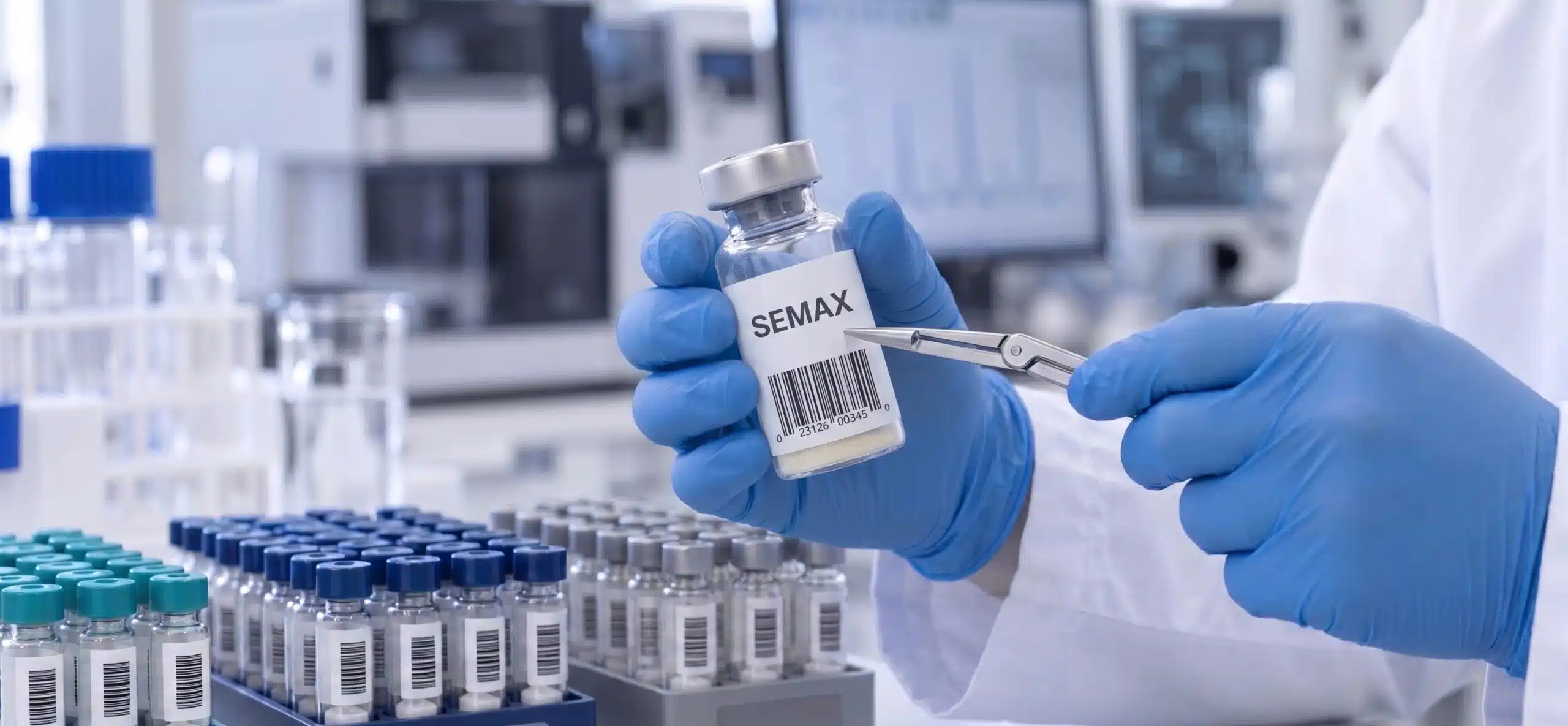
Semax is a synthetic peptide built from a fragment of adrenocorticotropic hormone (ACTH), extended with a stabilising Pro-Gly-Pro tail. It was first developed in the 1980s at the Institute of Molecular Genetics in Moscow. What does Semax do at a mechanistic level? Researchers have been building up an answer ever since, entirely in laboratories and animal models: Semax has not been approved for human consumption or use, and nothing here should be read as guidance for personal use.
What is Semax peptide?
Semax is a heptapeptide, a chain of seven amino acids, with the sequence Met-Glu-His-Phe-Pro-Gly-Pro. The first four residues correspond to ACTH(4-7), the part of adrenocorticotropic hormone linked to central nervous system activity rather than adrenal hormone release. The added Pro-Gly-Pro tail slows the peptide’s breakdown, giving it a longer functional window than the unmodified ACTH fragment, a design rationale set out by the research group that originally developed the peptide.
That’s the short answer to what is Semax peptide: a fragment of a natural hormone, re-engineered to separate its CNS-related activity from the steroidogenic effects of full-length ACTH. It’s also the starting point for every study that follows.
What does Semax do at a molecular level? Building the BDNF and NGF evidence base
Early evidence: 1996 and 2001
The earliest research into what Semax peptide does centred on neurotrophins, the proteins that support neuron survival and growth. In a 2001 study in Neuroscience Letters, Shadrina and colleagues found that Semax rapidly induced neurotrophin mRNA in rat glial cell cultures, an early in vitro signal that the peptide interacts with pathways involved in keeping neurons alive.
Human evidence actually predates that. Back in 1996, Koroleva and colleagues recorded measurable changes in the human EEG following Semax administration, in a study published in Bulletin of Experimental Biology and Medicine, showing the peptide had a detectable effect on the central nervous system in people, not just in cell cultures.
The BDNF breakthrough: 2006 to 2007
The mechanism came into sharper focus in 2006. Dolotov and colleagues reported in Brain Research that intranasal Semax increased BDNF protein and TrkB receptor phosphorylation in the rat hippocampus, tying the peptide directly to the BDNF-TrkB signalling axis. A companion paper published the same year in the Journal of Neurochemistry confirmed that Semax binds specifically in the rat basal forebrain and triggers a rapid rise in BDNF protein within three hours, adding protein-level evidence to what had previously been a genetic signal.
A year later, Agapova and colleagues took the picture whole-brain. Their 2007 study in Neuroscience Letters found rapid, region-specific changes in both BDNF and nerve growth factor (NGF) transcript levels across the normal rat brain, rather than one isolated effect. Together, these four studies establish the mechanistic foundation for Semax’s effect on neurotrophin signalling:
- 2001: Rapid neurotrophin mRNA induction in glial cell cultures (in vitro)
- 2006: BDNF protein increase and TrkB phosphorylation in rat hippocampus
- 2006: Confirmed basal forebrain binding and rapid BDNF protein rise
- 2007: Region-specific BDNF and NGF transcript changes across the rat brain
Genome-wide and transcriptional studies: how the mechanistic picture has deepened
2014 to 2017: mapping the genes
From 2014 onwards, research on Semax moved beyond single proteins and individual genes and started using genome-wide techniques to see the bigger picture. Medvedeva and colleagues ran a genome-wide transcriptional analysis, published in BMC Genomics, in rats with blood flow cut off to one part of the brain (a way of mimicking a stroke in the lab), finding that Semax predominantly increased the expression of immune-related genes, and separately affected genes involved in forming and maintaining the vascular system during ischemia.
The same group returned to the question in 2017, publishing a second transcriptome study in Molecular Genetics and Genomics, this time comparing whole Semax against its Pro-Gly-Pro fragment alone and confirming that Semax regulates immune-response gene expression during ischemic brain injury.
2020 to 2021: confirming the proteins
Filippenkov and colleagues extended this transcriptome-level analysis, publishing in Genes in 2020, this time in rats where blood flow was cut off and then let back in, which is when much of the actual damage in a stroke happens. A 2021 follow-up moved the analysis to the protein level: Sudarkina and colleagues, in the International Journal of Molecular Sciences, profiled specific proteins involved in inflammation and cell death (MMP-9, c-Fos, JNK) alongside markers of neuroprotection and recovery (CREB), confirming at the protein level what the earlier transcriptome studies had shown.
In plain terms: across these four studies, researchers blocked blood flow to part of a rat’s brain to mimic a stroke, then checked what changed in the tissue afterward. The 2014 and 2017 studies looked at which genes switched on, genes are essentially instructions, so a gene switching on means the cell starts producing more of something. Semax consistently turned up activity in genes tied to the immune response and to blood vessel repair.
The 2020 and 2021 studies went a step further and checked whether the actual proteins those genes code for showed up too. That matters because a gene switching on doesn’t always translate into anything happening; proteins are what actually do the work in a cell, so finding them there as well is stronger evidence than the genetic signal alone.
Taken together, the pattern across all four studies points the same way: less damaging inflammation, more support for blood vessel repair, and molecular markers linked to recovery rather than cell death.
Recent and ongoing research directions
Two newer strands of research show where Semax investigation stands today. In 2024, Inozemtseva and colleagues tested Semax in a chronic unpredictable stress model in rats, publishing in the European Journal of Pharmacology, and found it reversed or substantially reduced stress-induced anhedonia, weight-gain suppression, adrenal hypertrophy, and hippocampal BDNF reduction. Unlike the Russian-language clinical trials covered later in this article, this paper appears in an Elsevier-indexed Western journal.
A separate line of work has looked at how Semax interacts with copper and amyloid-beta, which sits closer to Alzheimer’s disease biology than to stroke or cognition research. A 2025 study by Tomasello and colleagues, published in Bioinorganic Chemistry and Applications, found that Semax can extract copper (II) ions from copper-amyloid-beta complexes and cut the reactive oxygen species that copper-catalysed oxidation produces, showing cytoprotective effects in SH-SY5Y neuroblastoma cells. This is a genuinely different mechanistic angle from the BDNF and genome-wide work covered above.
What the current evidence does and doesn’t establish
Put together, these studies build a consistent case that Semax interacts with neurotrophin signalling and affects gene expression relevant to neuroprotection, in animal models. That’s a substantial evidence base: the mechanistic work spans in vitro, whole-animal, genomic, and protein-level studies across more than two decades.
What it doesn’t establish matters just as much. Human clinical data for Semax does exist, including trials run by Gusev and colleagues in ischemic stroke patients, published in Zhurnal Nevrologii i Psikhiatrii in 2018, but that evidence sits almost entirely in Russian-language publications, wasn’t generally randomised, and lacked placebo controls. None of the studies cited in this article come from an independently repeated Western clinical trial.
Where a study mentions a dose used in a clinical trial, that figure describes what researchers gave to trial subjects under clinical supervision, nothing more. It isn’t usage guidance, and Semax remains unapproved for human consumption or use outside licensed clinical research.
Semax research formats at River Peptides: powder and nasal spray
The studies covered in this timeline mostly used intranasal administration, simply because that’s the route used in most of the animal and clinical work cited above, not because it’s being recommended here. River Peptides supplies Semax as a 10mg lyophilised powder, alongside a 10mg nasal spray research format. Both are intended strictly for laboratory research.
Every batch goes through third-party testing by Janoshik Laboratories and Analiza Biatek using HPLC and mass spectrometry, with the company holding ISO 9001 and ISO 14001 accreditation, so researchers working from the literature above have a documented basis for the identity and purity of the material they’re studying with. This is a research supply chain, not a consumer product. Semax isn’t licensed as a medicine in the UK, and researchers should check the Medicines and Healthcare products Regulatory Agency (MHRA) for the current regulatory position on unlicensed compounds. The full Semax range, alongside other cognitive and nootropic research peptides, is available through River Peptides.
Frequently asked questions
What is Semax used for in research?
Semax is used in research settings to study neurotrophin signalling, particularly BDNF and NGF expression, and its relevance to neuroprotection in models of ischemia and stress. If you’re asking what is Semax peptide used for, the research covered in this article sits mainly in animal models of stroke, cerebrovascular insufficiency, and more recently, chronic stress. None of it amounts to evidence for human use outside a licensed clinical research setting.
What is Semax nasal spray, and how does it differ from the powder form?
Semax nasal spray is a liquid research format built to mirror the intranasal route used in most of the studies covered above. If you’re asking what is Semax spray specifically, as opposed to the powder, it’s supplied ready-to-use rather than requiring reconstitution. The powder form is a lyophilised (freeze-dried) vial meant for laboratory reconstitution. Both are supplied by River Peptides strictly for research use, and neither is approved for human consumption.
Semax: what is it, in short?
Semax is a synthetic seven-amino-acid peptide derived from a fragment of ACTH, studied since the 1980s for its effects on neurotrophin signalling and neuroprotection in animal and laboratory research. It isn’t an approved medicine or supplement, and it isn’t intended for human or animal consumption outside of licensed research settings.