Blog
How Much Bacteriostatic Water to Use Per Vial: Reconstitution Ratios by Compound

There is no single correct answer to how much bacteriostatic water goes into a vial. The right volume depends on the vial’s total content and the concentration you want to end up with. The bacteriostatic water to peptide ratio is simply a matter of dividing milligrams by millilitres, and once you understand that calculation, you can reconstitute any vial correctly, regardless of what is in it.
This guide covers the maths behind the ratio, how it translates into syringe units, and the correct technique for mixing a vial without damaging the compound inside it.
Working Out Your Reconstitution Ratio
Reconstitution means adding a liquid, almost always bacteriostatic water, to a freeze-dried (lyophilised) compound so it can be measured and drawn up accurately. The compound itself does not change when you add water. Only its concentration does.
The formula is straightforward:
Concentration (mg/mL) = Total milligrams in the vial ÷ Millilitres of bacteriostatic water added
Take a 10mg vial as a worked example. Add 2mL of bacteriostatic water and the resulting solution is 5mg/mL. Add 5mL instead and the same 10mg is now spread across a larger volume, giving 2mg/mL. Neither figure is wrong: more water produces a more dilute solution with finer control over small doses, while less water concentrates it and means drawing up less liquid per dose.
There is no universal “correct” ratio. The right volume depends on what dose you are working with and how precisely you need to measure it.
Reconstitution Ratios by Compound
The table below sets out common starting ranges for the compounds River Peptides stocks. These are illustrative ranges rather than fixed instructions. Always check the exact peptide content on the product page before calculating your own ratio, since actual stocked quantities vary.
Vials are supplied in a 3mL container, so the bacteriostatic water added should never exceed that capacity.
| Compound | Peptide Content | Typical bacteriostatic water range | Resulting concentration |
| BPC-157 | 5mg to 10mg | 2mL to 3mL | 1.7mg/mL to 5mg/mL |
| CJC-1295 with DAC | 2mg to 5mg | 2mL | 1mg/mL to 2.5mg/mL |
| Ipamorelin | 5mg to 10mg | 2mL to 3mL | 1.7mg/mL to 5mg/mL |
| Sermorelin | 5mg | 2mL to 3mL | 1.7mg/mL to 2.5mg/mL |
| Tesamorelin | 5mg to 10mg | 2mL to 3mL | 1.7mg/mL to 5mg/mL |
| TB-500 | 5mg to 10mg | 2mL to 3mL | 1.7mg/mL to 5mg/mL |
Converting mg/mL to Syringe Units
Once you know the concentration, the next step is working out how much solution to draw up for a given dose. Most researchers use a U-100 insulin syringe, which holds 100 units per millilitre.
Take a vial reconstituted to 5mg/mL. A 250mcg (0.25mg) dose works out to 0.05mL, which is 5 units on a U-100 syringe. A U-40 syringe holds only 40 units per millilitre, so the same volume would read differently on the barrel markings. Mixing up the two syringe types is one of the most common measurement errors, so check which one you are holding before drawing up a dose.
How to Reconstitute a Vial Safely
The technique matters as much as the ratio. Lyophilised compounds are fragile, and rough handling during mixing can degrade them before they are ever used.
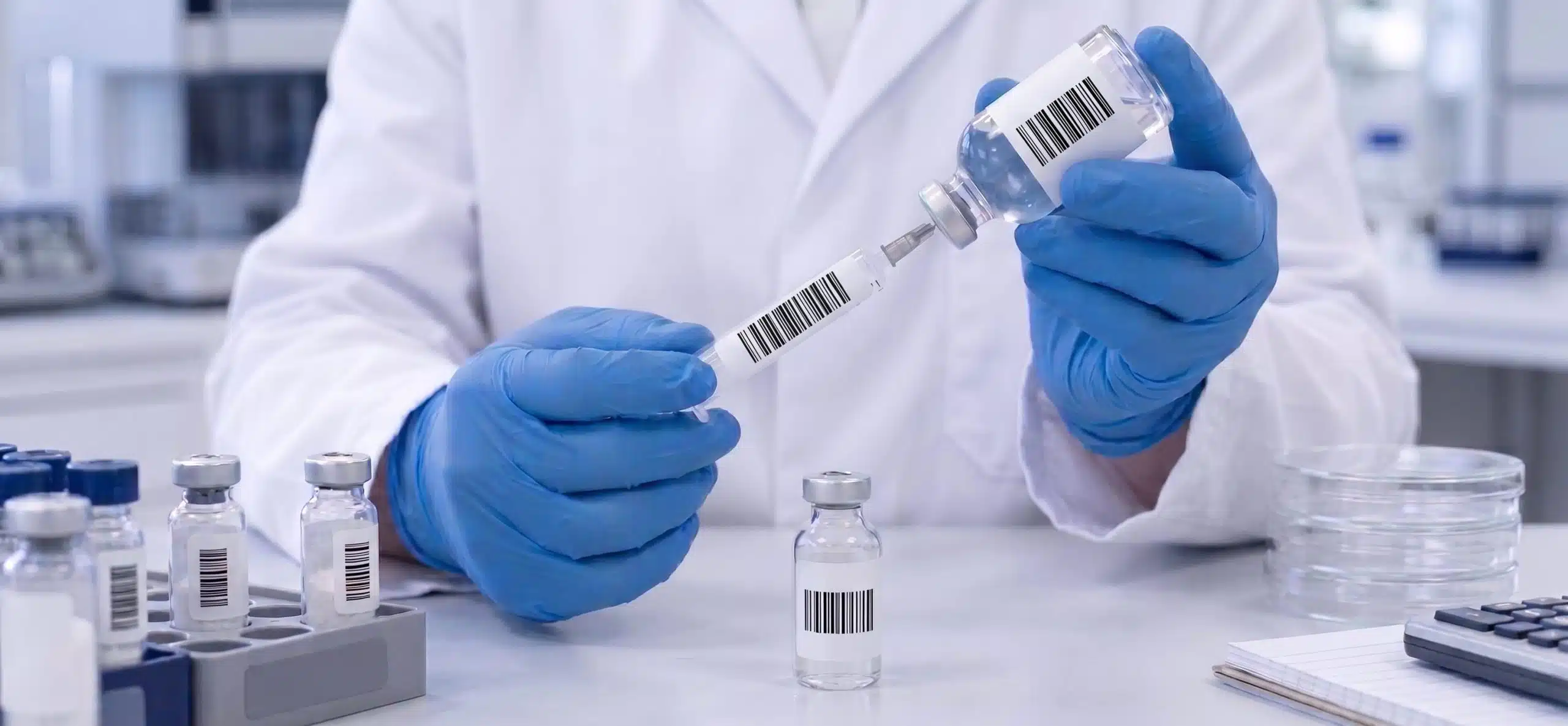
- Draw the bacteriostatic water first. Pull the intended volume into a sterile syringe before touching the vial containing the compound.
- Inject slowly, down the inside wall of the vial. Angle the needle so the water runs down the glass rather than striking the powder directly.
- Swirl gently. Do not shake. Shaking introduces mechanical stress that can break down the compound’s structure. Rolling the vial between your palms or swirling it in a slow circular motion is enough to dissolve the powder.
- Check the solution is clear. A properly reconstituted vial should look clear, with no visible particles or cloudiness. If it looks off, do not use it.
Storage After Reconstitution
Once a vial has been reconstituted, it should be kept refrigerated and protected from light. Bacteriostatic water contains a preservative, which is what allows a vial to be entered multiple times rather than needing to be used all at once, but refrigeration still matters for maintaining stability.
How long a reconstituted vial remains usable varies by compound, so check the specific product page for that compound rather than relying on a generic timeframe applied across the board.
Frequently Asked Questions
What is bacteriostatic water used for?
Bacteriostatic water is sterile water containing a small amount of preservative, most commonly benzyl alcohol. It is used to dissolve lyophilised compounds into a liquid solution that can be measured and drawn up with a syringe.
How do you use bacteriostatic water?
Draw the required volume into a sterile syringe, inject it slowly down the inside wall of the vial, then swirl gently until the powder is fully dissolved. Avoid shaking the vial.
How much benzyl alcohol is in bacteriostatic water?
Bacteriostatic water is typically formulated with around 0.9% benzyl alcohol as a preservative, in line with USP prescribing standards for bacteriostatic water for injection.